



Description
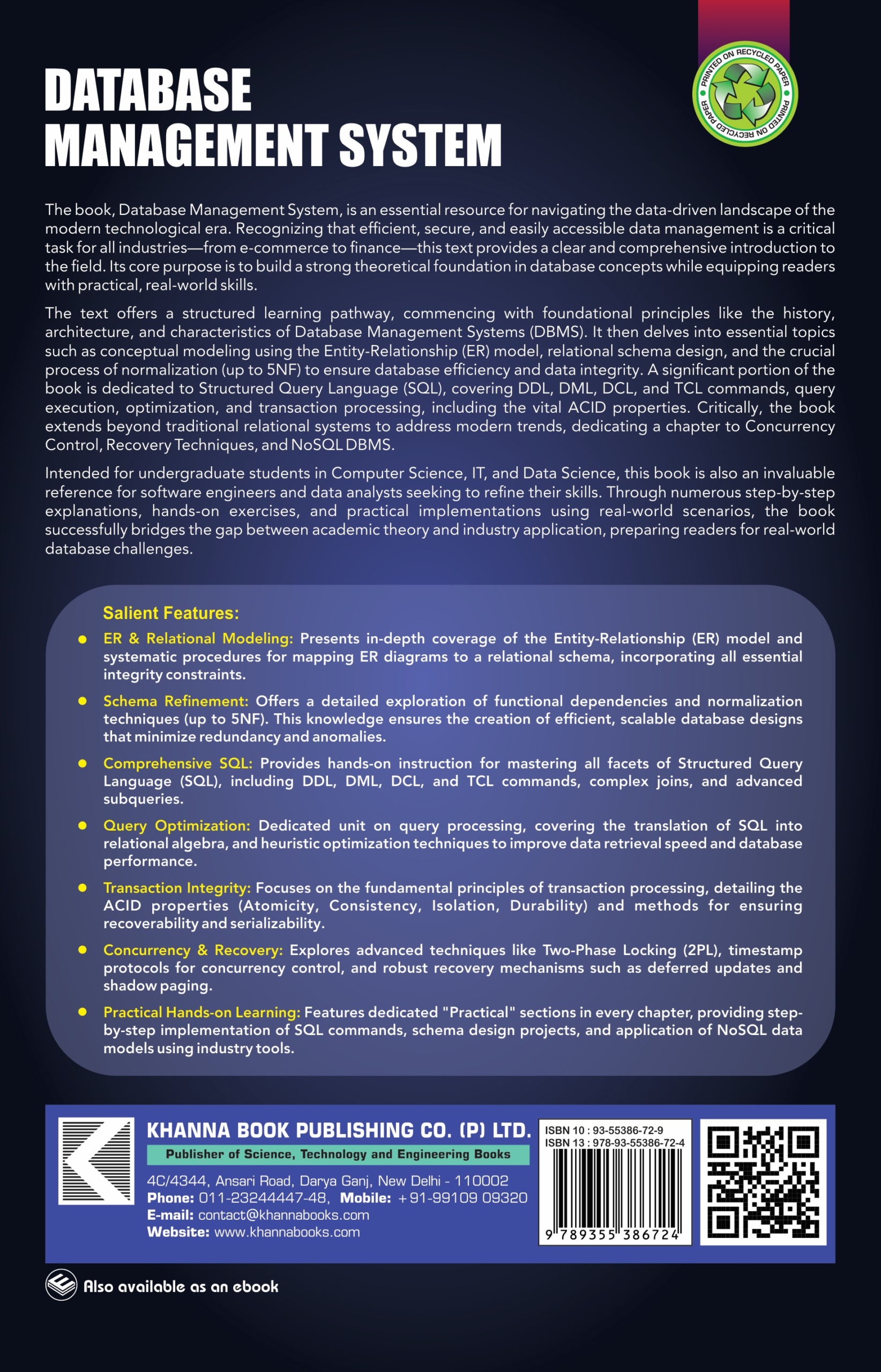
The book, Database Management System, is an essential resource for navigating the data-driven landscape of the modern technological era. Recognizing that efficient, secure, and easily accessible data management is a critical task for all industries—from e-commerce to finance—this text provides a clear and comprehensive introduction to the field. Its core purpose is to build a strong theoretical foundation in database concepts while equipping readers with practical, real-world skills.
The text offers a structured learning pathway, commencing with foundational principles like the history, architecture, and characteristics of Database Management Systems (DBMS). It then delves into essential topics such as conceptual modeling using the Entity-Relationship (ER) model, relational schema design, and the crucial process of normalization (up to 5NF) to ensure database efficiency and data integrity. A significant portion of the book is dedicated to Structured Query Language (SQL), covering DDL, DML, DCL, and TCL commands, query execution, optimization, and transaction processing, including the vital ACID properties. Critically, the book extends beyond traditional relational systems to address modern trends, dedicating a chapter to Concurrency Control, Recovery Techniques, and NoSQL DBMS.
Intended for undergraduate students in Computer Science, IT, and Data Science, this book is also an invaluable reference for software engineers and data analysts seeking to refine their skills. Through numerous step-by-step explanations, hands-on exercises, and practical implementations using real-world scenarios, the book successfully bridges the gap between academic theory and industry application, preparing readers for real-world database challenges.
Salient Features:
• ER & Relational Modeling: Presents in-depth coverage of the Entity-Relationship (ER) model and systematic procedures for mapping ER diagrams to a relational schema, incorporating all essential integrity constraints.
• Schema Refinement: Offers a detailed exploration of functional dependencies and normalization techniques (up to 5NF). This knowledge ensures the creation of efficient, scalable database designs that minimize redundancy and anomalies.
• Comprehensive SQL: Provides hands-on instruction for mastering all facets of Structured Query Language (SQL), including DDL, DML, DCL, and TCL commands, complex joins, and advanced subqueries.
• Query Optimization: Dedicated unit on query processing, covering the translation of SQL into relational algebra, and heuristic optimization techniques to improve data retrieval speed and database performance.
• Transaction Integrity: Focuses on the fundamental principles of transaction processing, detailing the ACID properties (Atomicity, Consistency, Isolation, Durability) and methods for ensuring recoverability and serializability.
• Concurrency & Recovery: Explores advanced techniques like Two-Phase Locking (2PL), timestamp protocols for concurrency control, and robust recovery mechanisms such as deferred updates and shadow paging.
• Practical Hands-on Learning: Features dedicated “Practical” sections in every chapter, providing step-by-step implementation of SQL commands, schema design projects, and application of NoSQL data models using industry tools.






Reviews
There are no reviews yet.