



Description
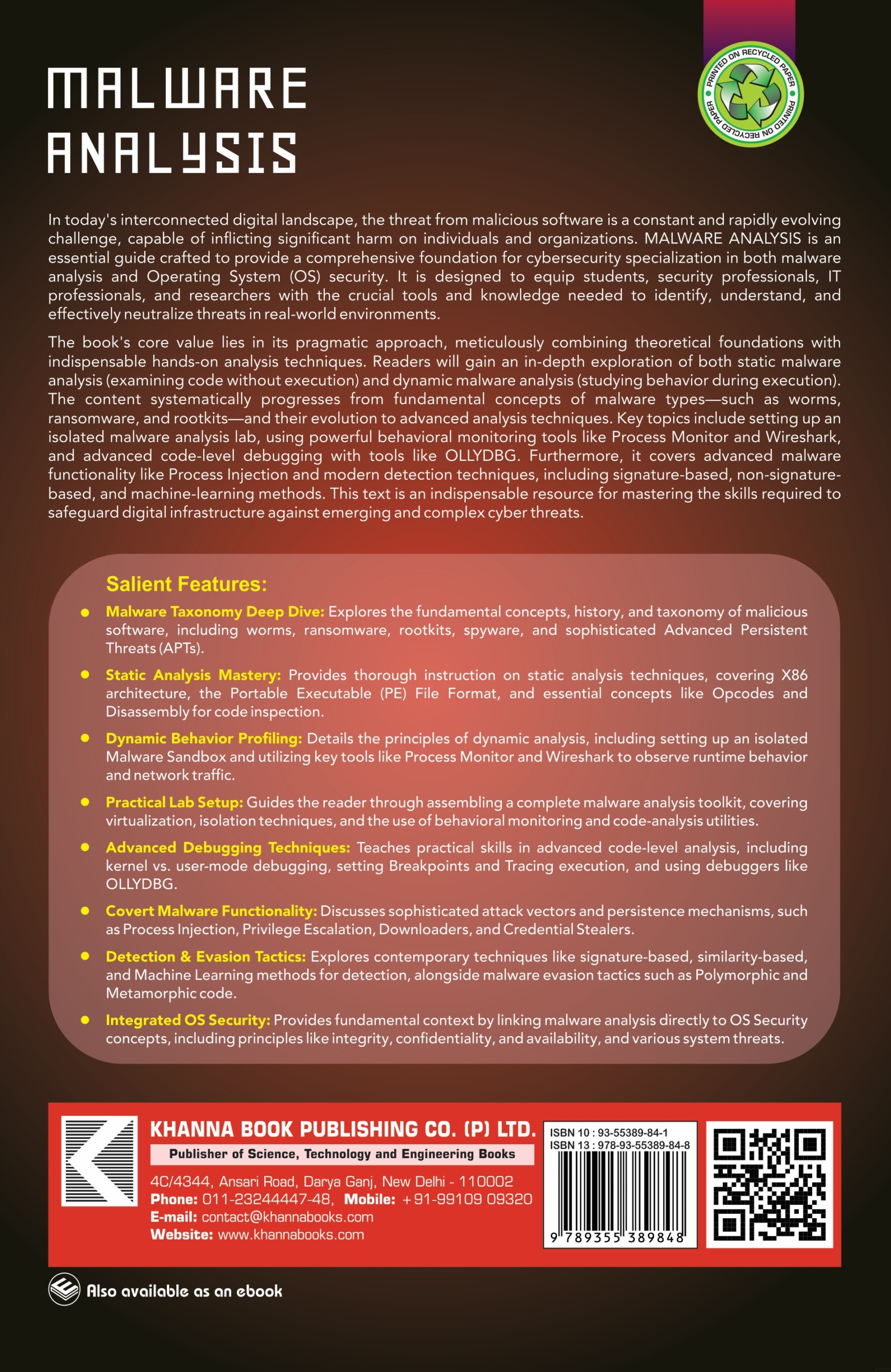
In today’s interconnected digital landscape, the threat from malicious software is a constant and rapidly evolving challenge, capable of inflicting significant harm on individuals and organizations. MALWARE ANALYSIS is an essential guide crafted to provide a comprehensive foundation for cybersecurity specialization in both malware analysis and Operating System (OS) security. It is designed to equip students, security professionals, IT professionals, and researchers with the crucial tools and knowledge needed to identify, understand, and effectively neutralize threats in real-world environments.
The book’s core value lies in its pragmatic approach, meticulously combining theoretical foundations with indispensable hands-on analysis techniques. Readers will gain an in-depth exploration of both static malware analysis (examining code without execution) and dynamic malware analysis (studying behavior during execution). The content systematically progresses from fundamental concepts of malware types—such as worms, ransomware, and rootkits—and their evolution to advanced analysis techniques. Key topics include setting up an isolated malware analysis lab, using powerful behavioral monitoring tools like Process Monitor and Wireshark, and advanced code-level debugging with tools like OLLYDBG. Furthermore, it covers advanced malware functionality like Process Injection and modern detection techniques, including signature-based, non-signature-based, and machine-learning methods. This text is an indispensable resource for mastering the skills required to safeguard digital infrastructure against emerging and complex cyber threats.
In today’s interconnected digital landscape, the threat from malicious software is a constant and rapidly evolving challenge, capable of inflicting significant harm on individuals and organizations. MALWARE ANALYSIS is an essential guide crafted to provide a comprehensive foundation for cybersecurity specialization in both malware analysis and Operating System (OS) security. It is designed to equip students, security professionals, IT professionals, and researchers with the crucial tools and knowledge needed to identify, understand, and effectively neutralize threats in real-world environments.
The book’s core value lies in its pragmatic approach, meticulously combining theoretical foundations with indispensable hands-on analysis techniques. Readers will gain an in-depth exploration of both static malware analysis (examining code without execution) and dynamic malware analysis (studying behavior during execution). The content systematically progresses from fundamental concepts of malware types—such as worms, ransomware, and rootkits—and their evolution to advanced analysis techniques. Key topics include setting up an isolated malware analysis lab, using powerful behavioral monitoring tools like Process Monitor and Wireshark, and advanced code-level debugging with tools like OLLYDBG. Furthermore, it covers advanced malware functionality like Process Injection and modern detection techniques, including signature-based, non-signature-based, and machine-learning methods. This text is an indispensable resource for mastering the skills required to safeguard digital infrastructure against emerging and complex cyber threats.
Salient Features:
● Malware Taxonomy Deep Dive: Explores the fundamental concepts, history, and taxonomy of malicious software, including worms, ransomware, rootkits, spyware, and sophisticated Advanced Persistent Threats (APTs).
● Static Analysis Mastery: Provides thorough instruction on static analysis techniques, covering X86 architecture, the Portable Executable (PE) File Format, and essential concepts like Opcodes and Disassembly for code inspection.
● Dynamic Behavior Profiling: Details the principles of dynamic analysis, including setting up an isolated Malware Sandbox and utilizing key tools like Process Monitor and Wireshark to observe runtime behavior and network traffic.
● Practical Lab Setup: Guides the reader through assembling a complete malware analysis toolkit, covering virtualization, isolation techniques, and the use of behavioral monitoring and code-analysis utilities.
● Advanced Debugging Techniques: Teaches practical skills in advanced code-level analysis, including kernel vs. user-mode debugging, setting Breakpoints and Tracing execution, and using debuggers like OLLYDBG.
● Covert Malware Functionality: Discusses sophisticated attack vectors and persistence mechanisms, such as Process Injection, Privilege Escalation, Downloaders, and Credential Stealers.
● Detection & Evasion Tactics: Explores contemporary techniques like signature-based, similarity-based, and Machine Learning methods for detection, alongside malware evasion tactics such as Polymorphic and Metamorphic code.
● Integrated OS Security: Provides fundamental context by linking malware analysis directly to OS Security concepts, including principles like integrity, confidentiality, and availability, and various system threats.
● Malware Taxonomy Deep Dive: Explores the fundamental concepts, history, and taxonomy of malicious software, including worms, ransomware, rootkits, spyware, and sophisticated Advanced Persistent Threats (APTs).
● Static Analysis Mastery: Provides thorough instruction on static analysis techniques, covering X86 architecture, the Portable Executable (PE) File Format, and essential concepts like Opcodes and Disassembly for code inspection.
● Dynamic Behavior Profiling: Details the principles of dynamic analysis, including setting up an isolated Malware Sandbox and utilizing key tools like Process Monitor and Wireshark to observe runtime behavior and network traffic.
● Practical Lab Setup: Guides the reader through assembling a complete malware analysis toolkit, covering virtualization, isolation techniques, and the use of behavioral monitoring and code-analysis utilities.
● Advanced Debugging Techniques: Teaches practical skills in advanced code-level analysis, including kernel vs. user-mode debugging, setting Breakpoints and Tracing execution, and using debuggers like OLLYDBG.
● Covert Malware Functionality: Discusses sophisticated attack vectors and persistence mechanisms, such as Process Injection, Privilege Escalation, Downloaders, and Credential Stealers.
● Detection & Evasion Tactics: Explores contemporary techniques like signature-based, similarity-based, and Machine Learning methods for detection, alongside malware evasion tactics such as Polymorphic and Metamorphic code.
● Integrated OS Security: Provides fundamental context by linking malware analysis directly to OS Security concepts, including principles like integrity, confidentiality, and availability, and various system threats.









![Mathematics I Calculus and Linear Algebra [For Computer Science Engineering Branches] (Marathi)](https://khannabooks.com/wp-content/uploads/2023/10/978-93-5538-038-8.jpg)

Reviews
There are no reviews yet.