



Description
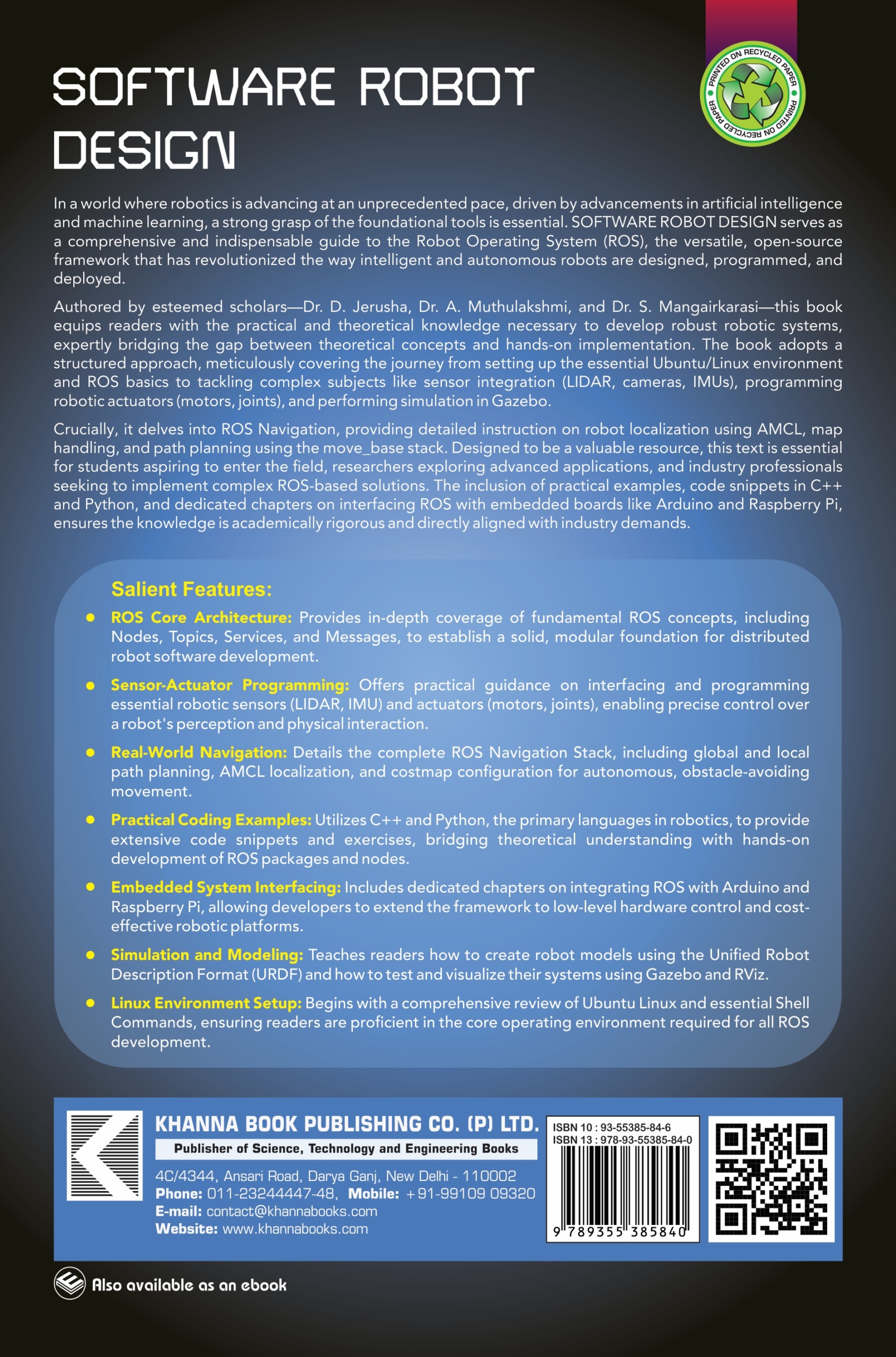
In a world where robotics is advancing at an unprecedented pace, driven by advancements in artificial intelligence and machine learning, a strong grasp of the foundational tools is essential. SOFTWARE ROBOT DESIGN serves as a comprehensive and indispensable guide to the Robot Operating System (ROS), the versatile, open-source framework that has revolutionized the way intelligent and autonomous robots are designed, programmed, and deployed.
Authored by esteemed scholars—Dr. D. Jerusha, Dr. A. Muthulakshmi, and Dr. S. Mangairkarasi—this book equips readers with the practical and theoretical knowledge necessary to develop robust robotic systems, expertly bridging the gap between theoretical concepts and hands-on implementation. The book adopts a structured approach, meticulously covering the journey from setting up the essential Ubuntu/Linux environment and ROS basics to tackling complex subjects like sensor integration (LIDAR, cameras, IMUs), programming robotic actuators (motors, joints), and performing simulation in Gazebo.
Crucially, it delves into ROS Navigation, providing detailed instruction on robot localization using AMCL, map handling, and path planning using the move_base stack. Designed to be a valuable resource, this text is essential for students aspiring to enter the field, researchers exploring advanced applications, and industry professionals seeking to implement complex ROS-based solutions. The inclusion of practical examples, code snippets in C++ and Python, and dedicated chapters on interfacing ROS with embedded boards like Arduino and Raspberry Pi, ensures the knowledge is academically rigorous and directly aligned with industry demands.
Salient Features:
• ROS Core Architecture: Provides in-depth coverage of fundamental ROS concepts, including Nodes, Topics, Services, and Messages, to establish a solid, modular foundation for distributed robot software development.
• Sensor-Actuator Programming: Offers practical guidance on interfacing and programming essential robotic sensors (LIDAR, IMU) and actuators (motors, joints), enabling precise control over a robot’s perception and physical interaction.
• Real-World Navigation: Details the complete ROS Navigation Stack, including global and local path planning, AMCL localization, and costmap configuration for autonomous, obstacle-avoiding movement.
• Practical Coding Examples: Utilizes C++ and Python, the primary languages in robotics, to provide extensive code snippets and exercises, bridging theoretical understanding with hands-on development of ROS packages and nodes.
• Embedded System Interfacing: Includes dedicated chapters on integrating ROS with Arduino and Raspberry Pi, allowing developers to extend the framework to low-level hardware control and cost-effective robotic platforms.
• Simulation and Modeling: Teaches readers how to create robot models using the Unified Robot Description Format (URDF) and how to test and visualize their systems using Gazebo and RViz.
• Linux Environment Setup: Begins with a comprehensive review of Ubuntu Linux and essential Shell Commands, ensuring readers are proficient in the core operating environment required for all ROS development.








Reviews
There are no reviews yet.