



Description
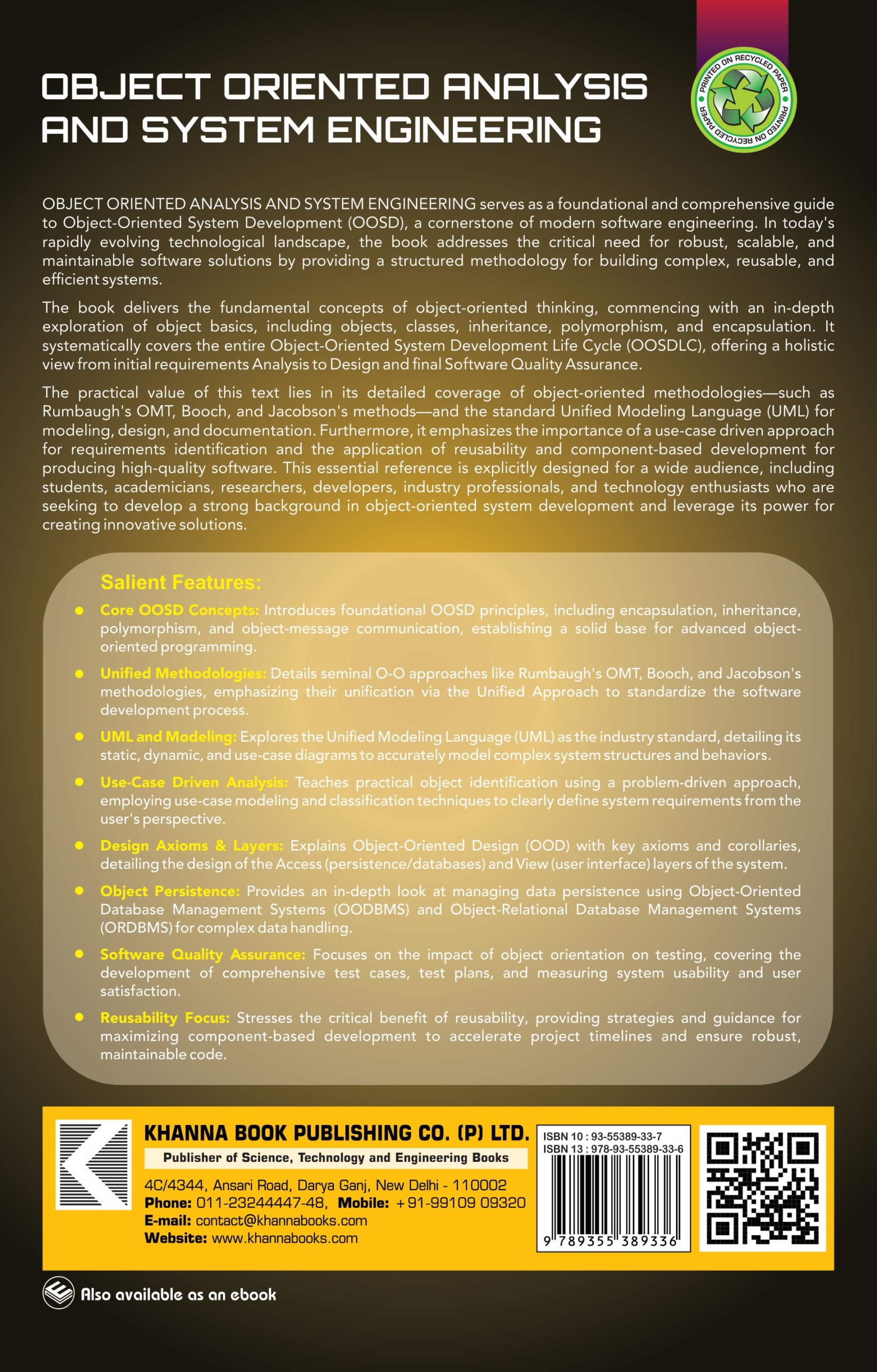
OBJECT ORIENTED ANALYSIS AND SYSTEM ENGINEERING serves as a foundational and comprehensive guide to Object-Oriented System Development (OOSD), a cornerstone of modern software engineering. In today’s rapidly evolving technological landscape, the book addresses the critical need for robust, scalable, and maintainable software solutions by providing a structured methodology for building complex, reusable, and efficient systems.
The book delivers the fundamental concepts of object-oriented thinking, commencing with an in-depth exploration of object basics, including objects, classes, inheritance, polymorphism, and encapsulation. It systematically covers the entire Object-Oriented System Development Life Cycle (OOSDLC), offering a holistic view from initial requirements Analysis to Design and final Software Quality Assurance.
The practical value of this text lies in its detailed coverage of object-oriented methodologies—such as Rumbaugh’s OMT, Booch, and Jacobson’s methods—and the standard Unified Modeling Language (UML) for modeling, design, and documentation. Furthermore, it emphasizes the importance of a use-case driven approach for requirements identification and the application of reusability and component-based development for producing high-quality software. This essential reference is explicitly designed for a wide audience, including students, academicians, researchers, developers, industry professionals, and technology enthusiasts who are seeking to develop a strong background in object-oriented system development and leverage its power for creating innovative solutions.
Salient Features:
• Core OOSD Concepts: Introduces foundational OOSD principles, including encapsulation, inheritance, polymorphism, and object-message communication, establishing a solid base for advanced object-oriented programming.
• Unified Methodologies: Details seminal O-O approaches like Rumbaugh’s OMT, Booch, and Jacobson’s methodologies, emphasizing their unification via the Unified Approach to standardize the software development process.
• UML and Modeling: Explores the Unified Modeling Language (UML) as the industry standard, detailing its static, dynamic, and use-case diagrams to accurately model complex system structures and behaviors.
• Use-Case Driven Analysis: Teaches practical object identification using a problem-driven approach, employing use-case modeling and classification techniques to clearly define system requirements from the user’s perspective.
• Design Axioms & Layers: Explains Object-Oriented Design (OOD) with key axioms and corollaries, detailing the design of the Access (persistence/databases) and View (user interface) layers of the system.
• Object Persistence: Provides an in-depth look at managing data persistence using Object-Oriented Database Management Systems (OODBMS) and Object-Relational Database Management Systems (ORDBMS) for complex data handling.
• Software Quality Assurance: Focuses on the impact of object orientation on testing, covering the development of comprehensive test cases, test plans, and measuring system usability and user satisfaction.
• Reusability Focus: Stresses the critical benefit of reusability, providing strategies and guidance for maximizing component-based development to accelerate project timelines and ensure robust, maintainable code.







Reviews
There are no reviews yet.