


Description
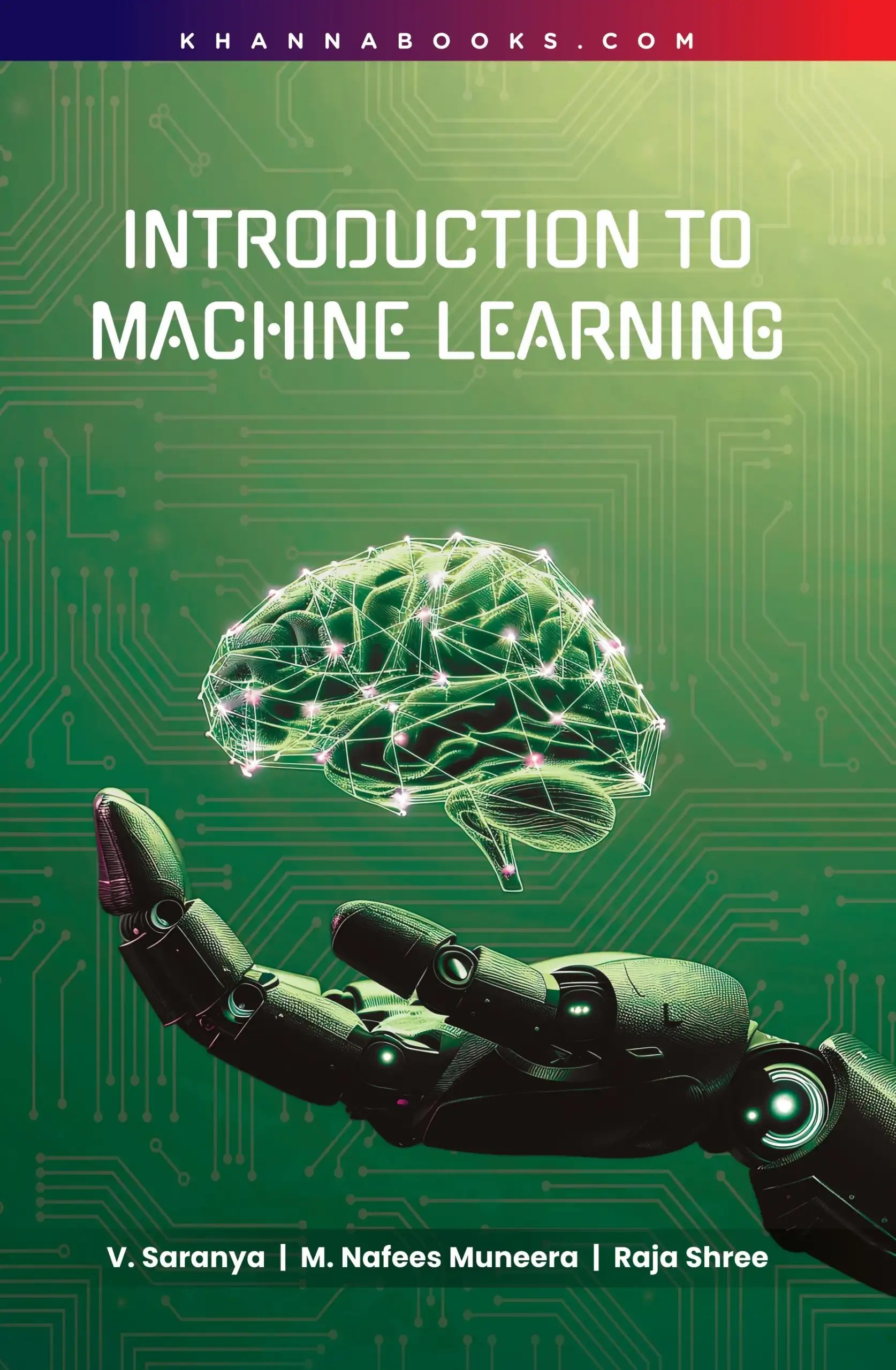
The book, INTRODUCTION TO MACHINE LEARNING, is an essential guide meticulously designed to provide a comprehensive, progressive, and practical foundation in the field of Machine Learning (ML). In the rapidly advancing “data era,” ML has become an integral part of modern advancements across healthcare, finance, autonomous systems, and artificial intelligence. This textbook is dedicated to crafting a strong foundational understanding of the principles, techniques, and real-world applications that drive these intelligent systems.
The core purpose of this book is to bridge the gap between theoretical understanding and practical application. It begins with the fundamental concepts of ML, its categories (supervised, unsupervised, semi-supervised, and reinforcement learning), and essential data preprocessing techniques. The journey progresses through the crucial mathematical backbone, including probability, distributions, and the Naive Bayes Classifier. It then thoroughly explores core supervised algorithms like Linear Regression and Support Vector Machines (SVM), and dives into unsupervised methods such as K-Means clustering and Principal Component Analysis (PCA). Finally, it addresses advanced concepts in model optimization through ensemble methods like bagging, boosting, and stacked generalization.
This resource is an invaluable companion for students building their academic foundation, researchers seeking clear insights, and professionals aiming to integrate ML into their work. The content is structured with clarity and is supported by well-illustrated examples, making it suitable for both beginners and experienced learners who wish to master the application of ML techniques effectively in various domains.
Salient Features:
• Foundational Principles: Provides a solid, structured introduction to Machine Learning, its core concepts, types (supervised, unsupervised, etc.), and the critical bias-variance tradeoff.
• Essential Preprocessing: Covers crucial initial steps of the ML workflow, including noise removal, normalization techniques, and an understanding of data quality challenges.
• Statistical Backbone: Dedicated unit on the mathematical foundations, including random variables, probability distributions, Bayes’ Theorem, and the Naive Bayes Classifier Algorithm.
• Supervised Algorithms: Detailed coverage of key supervised methods like Linear Regression, Lasso Regression, Logistic Regression, Support Vector Machines (SVM), and K-Nearest Neighbors (KNN).
• Unsupervised Deep Dive: Explores clustering techniques (K-Means, K-Medoids, DBSCAN), dimensionality reduction with PCA, Outlier Analysis, and an introduction to Reinforcement Learning.
• Model Evaluation: Discusses essential evaluation metrics for both regression and classification tasks, ensuring readers can accurately measure and validate their model performance.
• Advanced Optimization: Focuses on model generalization and optimization using ensemble learning, covering techniques like Bagging, Boosting, Stacked Generalization, and Cascading.
• Practical Application: Emphasizes practical skills and insights necessary for applying ML techniques effectively in real-world scenarios across various domains, supported by clear examples.






Reviews
There are no reviews yet.