



Description
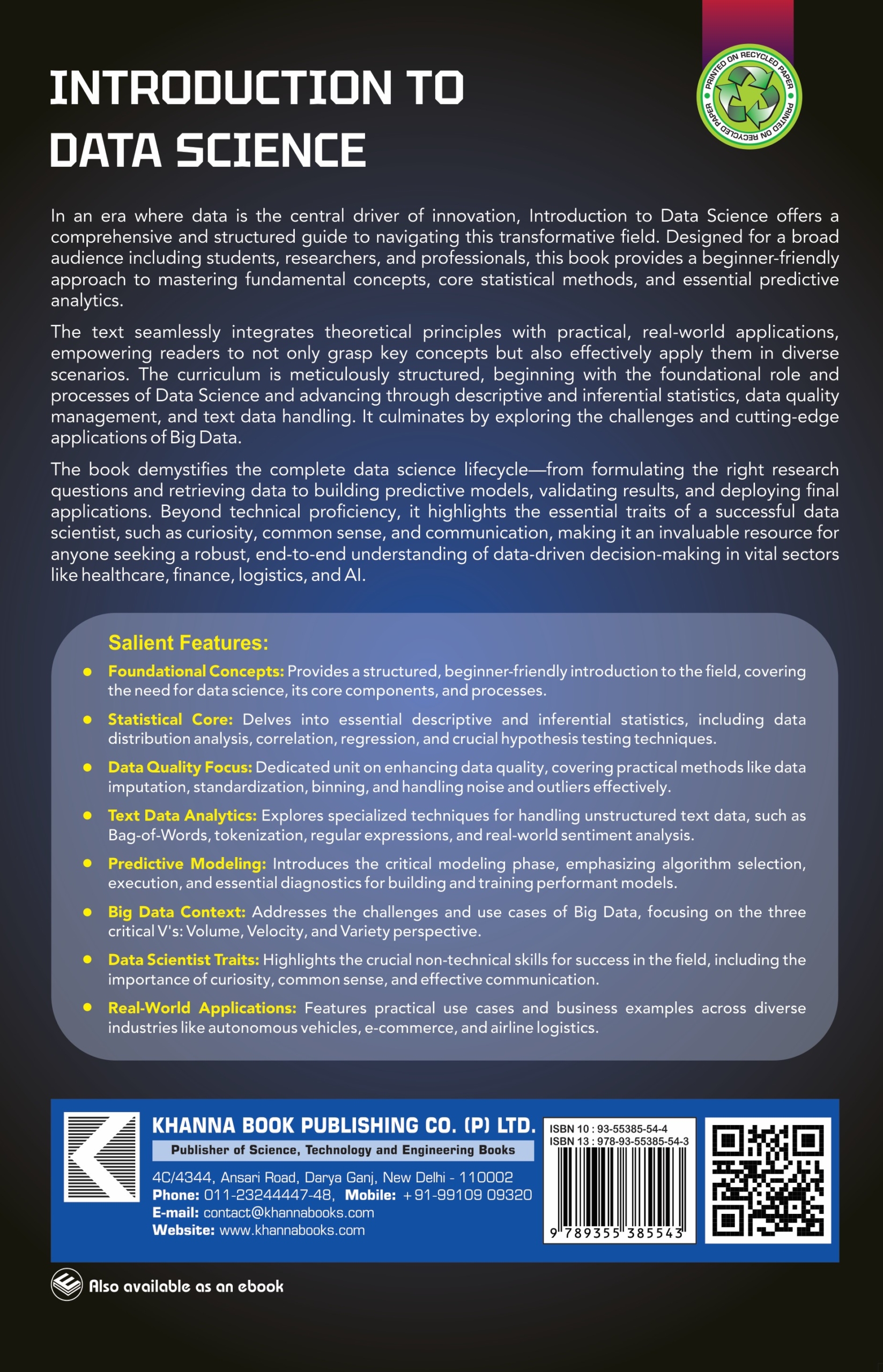
In an era where data is the central driver of innovation, Introduction to Data Science offers a comprehensive and structured guide to navigating this transformative field. Designed for a broad audience including students, researchers, and professionals, this book provides a beginner-friendly approach to mastering fundamental concepts, core statistical methods, and essential predictive analytics.
The text seamlessly integrates theoretical principles with practical, real-world applications, empowering readers to not only grasp key concepts but also effectively apply them in diverse scenarios. The curriculum is meticulously structured, beginning with the foundational role and processes of Data Science and advancing through descriptive and inferential statistics, data quality management, and text data handling. It culminates by exploring the challenges and cutting-edge applications of Big Data.
The book demystifies the complete data science lifecycle—from formulating the right research questions and retrieving data to building predictive models, validating results, and deploying final applications. Beyond technical proficiency, it highlights the essential traits of a successful data scientist, such as curiosity, common sense, and communication, making it an invaluable resource for anyone seeking a robust, end-to-end understanding of data-driven decision-making in vital sectors like healthcare, finance, logistics, and AI.
Salient Features:
• Foundational Concepts: Provides a structured, beginner-friendly introduction to the field, covering the need for data science, its core components, and processes.
• Statistical Core: Delves into essential descriptive and inferential statistics, including data distribution analysis, correlation, regression, and crucial hypothesis testing techniques.
• Data Quality Focus: Dedicated unit on enhancing data quality, covering practical methods like data imputation, standardization, binning, and handling noise and outliers effectively.
• Text Data Analytics: Explores specialized techniques for handling unstructured text data, such as Bag-of-Words, tokenization, regular expressions, and real-world sentiment analysis.
• Predictive Modeling: Introduces the critical modeling phase, emphasizing algorithm selection, execution, and essential diagnostics for building and training performant models.
• Big Data Context: Addresses the challenges and use cases of Big Data, focusing on the three critical V’s: Volume, Velocity, and Variety perspective.
• Data Scientist Traits: Highlights the crucial non-technical skills for success in the field, including the importance of curiosity, common sense, and effective communication.
• Real-World Applications: Features practical use cases and business examples across diverse industries like autonomous vehicles, e-commerce, and airline logistics.










Reviews
There are no reviews yet.