



Description
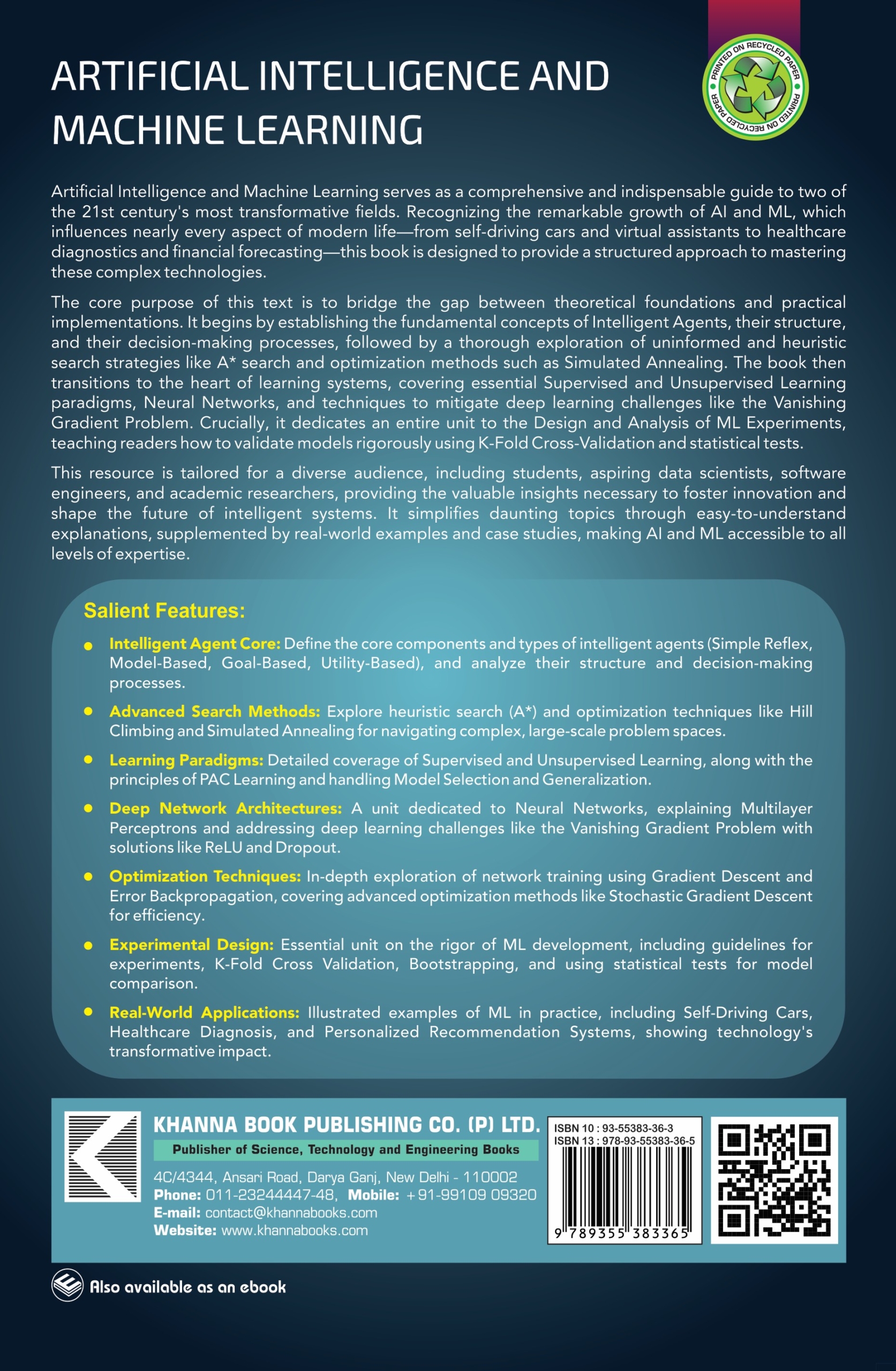
Artificial Intelligence and Machine Learning serves as a comprehensive and indispensable guide to two of the 21st century’s most transformative fields. Recognizing the remarkable growth of AI and ML, which influences nearly every aspect of modern life—from self-driving cars and virtual assistants to healthcare diagnostics and financial forecasting—this book is designed to provide a structured approach to mastering these complex technologies.
The core purpose of this text is to bridge the gap between theoretical foundations and practical implementations. It begins by establishing the fundamental concepts of Intelligent Agents, their structure, and their decision-making processes, followed by a thorough exploration of uninformed and heuristic search strategies like A* search and optimization methods such as Simulated Annealing. The book then transitions to the heart of learning systems, covering essential Supervised and Unsupervised Learning paradigms, Neural Networks, and techniques to mitigate deep learning challenges like the Vanishing Gradient Problem. Crucially, it dedicates an entire unit to the Design and Analysis of ML Experiments, teaching readers how to validate models rigorously using K-Fold Cross-Validation and statistical tests.
This resource is tailored for a diverse audience, including students, aspiring data scientists, software engineers, and academic researchers, providing the valuable insights necessary to foster innovation and shape the future of intelligent systems. It simplifies daunting topics through easy-to-understand explanations, supplemented by real-world examples and case studies, making AI and ML accessible to all levels of expertise.
Salient Features:
• Intelligent Agent Core: Define the core components and types of intelligent agents (Simple Reflex, Model-Based, Goal-Based, Utility-Based), and analyze their structure and decision-making processes.
• Advanced Search Methods: Explore heuristic search (A*) and optimization techniques like Hill Climbing and Simulated Annealing for navigating complex, large-scale problem spaces.
• Learning Paradigms: Detailed coverage of Supervised and Unsupervised Learning, along with the principles of PAC Learning and handling Model Selection and Generalization.
• Deep Network Architectures: A unit dedicated to Neural Networks, explaining Multilayer Perceptrons and addressing deep learning challenges like the Vanishing Gradient Problem with solutions like ReLU and Dropout.
• Optimization Techniques: In-depth exploration of network training using Gradient Descent and Error Backpropagation, covering advanced optimization methods like Stochastic Gradient Descent for efficiency.
• Experimental Design: Essential unit on the rigor of ML development, including guidelines for experiments, K-Fold Cross Validation, Bootstrapping, and using statistical tests for model comparison.
• Real-World Applications: Illustrated examples of ML in practice, including Self-Driving Cars, Healthcare Diagnosis, and Personalized Recommendation Systems, showing technology’s transformative impact.










Reviews
There are no reviews yet.