


Description
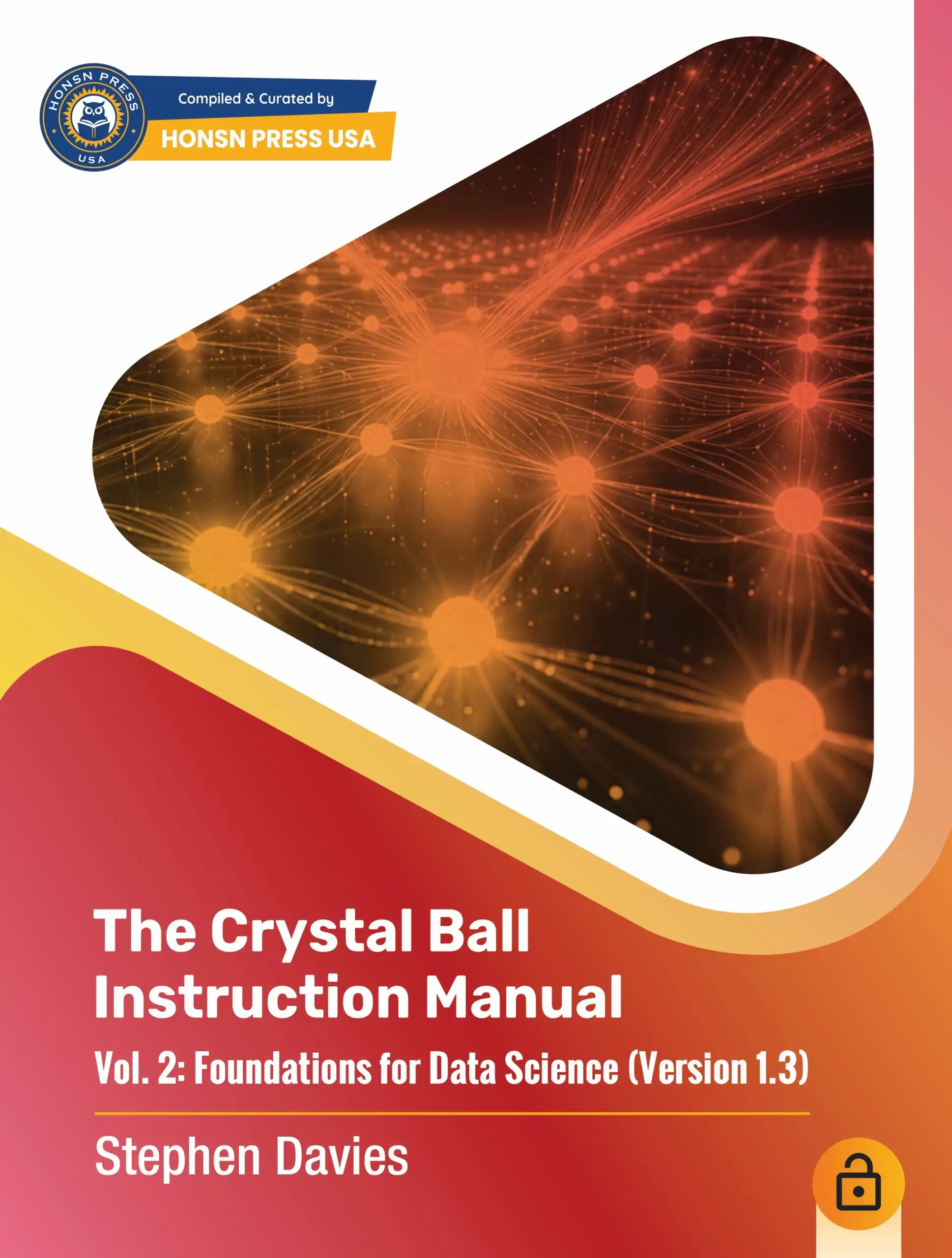
The Crystal Ball Instruction Manual, Volume Two: Foundations for Data Science, is the essential next step for learners ready to move beyond introductory concepts and establish mastery in the field. Designed for intermediate students, aspiring professionals, and researchers who have a working knowledge of foundational Python programming, this volume solidifies the core knowledge and practical skills necessary to build a robust data science skill set. It assumes a base level of competency, offering a swift review of essential concepts like statistical significance, exploratory data analysis (EDA) fundamentals, and classification/regression principles.
The book’s core theme is hands-on implementation, leveraging the Python ecosystem—including the Spyder IDE, NumPy, and Pandas—to tackle real-world data challenges. Its practical value is delivered through in-depth coverage of crucial data acquisition and wrangling techniques, such as parsing complex JSON and HTML using screen scraping, accessing databases, and data fusion to integrate multiple sources. It extends EDA with advanced visualization methods like heat maps and box plots, while simultaneously providing a solid grounding in machine learning principles like Naïve Bayes and kNN classification, along with essential pre-modeling steps like feature selection and association analysis.
Salient Features
• Foundational Data Principles: Reviews and solidifies core concepts like statistical significance, the crucial distinction between association and causality, and fundamental machine learning terminology.
• Advanced Data Exploration: Extends Exploratory Data Analysis (EDA) skills with detailed instruction on Kernel Density Estimates (KDEs), various distribution plots, and bivariate categorical analysis.
• Real-World Data Acquisition: Provides practical techniques for collecting and structuring disparate data, including parsing complex JSON files, performing screen scraping (HTML), and directly accessing databases (SQLite).
• Effective Data Wrangling: Focuses on combining and restructuring data using techniques like data fusion, merging tables, and transforming datasets between long, wide, and the modern “tidy” form.
• Practical ML Algorithms: Delivers hands-on instruction for fundamental classification algorithms, including thorough multipart coverage of the Naïve Bayes classifier and the k-Nearest Neighbors (kNN) method.
• Statistical Modeling Insights: Covers probabilistic reasoning, the concepts of the prior and posterior, and the practical application of the LOWESS non-parametric local regression smoothing algorithm.
• Essential Pre-Modeling Techniques: Dedicated chapters explore critical preparatory steps such as feature selection to improve model performance and association analysis (like market basket analysis).
• Integrated Python Environment: Instructions are explicitly integrated with the Spyder IDE within the Anaconda distribution, ensuring seamless, hands-on application using industry-standard Python libraries.








Reviews
There are no reviews yet.