Description
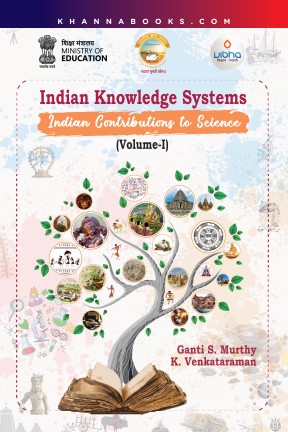
Indian Knowledge Systems (Indian Contributions to Science), Volume-I,
Indian Knowledge system (Volume-1): Indian Contribution to Science offers a profound journey into the intellectual heritage of India, presenting its timeless knowledge not as a historical artefact, but as vibrant and relevant resource for the contemporary modern world. This volume masterfully bridges the ancient and the contemporary, revealing how India’s holistic and interdisciplinary traditions – from astronomy and mathematics to chemistry medicine, ecology and agriculture—provide deep insights into the globally recognized academic and research fields of fundamental and applied sciences and technology. Meticulously researched and thoughtfully complied, this book is and essential read for students, educators, and anyone curious to discover the depth and sophistication of the Bhartiya Jnana Parampara also referred to as Indian Knowledge Systems (IKS).
Table of Contents
Messages
Foreword
From The Editors Desk
Acknowledgement
List Of Figures and Tables
A Note on LAST Diacritical Marks Used
- Introduction To IKS: Origins and Evolution
- Indian Astronomy: Calendrical Systems
- Indian Astronomical Instruments (Yantras)
- A Glimpse of Indian Mathematics
- A Glimpse of Indian Chemistry (Rasayanasastra)
- Ayurveda: The Holistic Science of Well-Being
- Traditional Medicinal Plants
- Indian Traditional Agriculture
About The IKS Division
Author
Prof. Ganti S. Murthy is a professor of Biosciences and Biomedical Engineering at the Indian Institute of Technology Indore. He serves as the National Coordinator for Indian Knowledge Systems (IKS), an initiative of the Ministry of Education, government of India, and is the founding Head of the center for Indian Scientific Knowledge Systems at IIT Indore. With a Ph.D. in Agricultural and Biological Engineering from the University of Illinois at Urban-Campaign, and prior tenure as a professor at Oregon State University, Professor Murthy brings a distinguished international research background to the study of traditional Indian agronomy. His scholarly work is focused on sustainable bioprocessing and the analysis of engineered systems, with a particular interest in the resilience of agro-ecological systems. He has played a pivotal role in numerous national committees, including those under the NCERT and UGC, aimed at incorporation IKS into educational curricula and policy. His research group is dedicated to developing sustainable solutions that are technically feasible, economically viable, and environmentally conscious.








Reviews
There are no reviews yet.