


Description
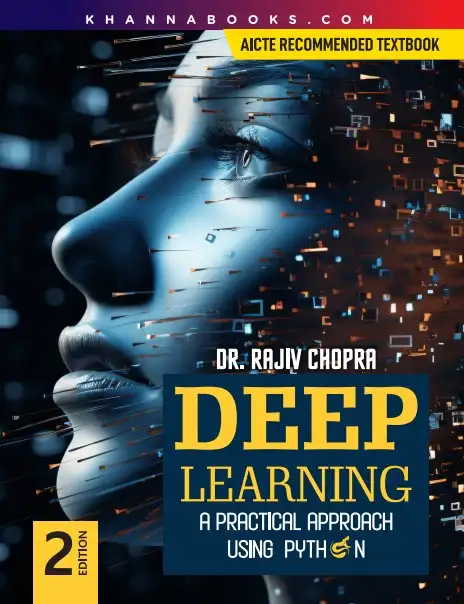
Deep Learning
This textbook, Deep Learning, serves as a comprehensive and structured introduction to the transformative field of Artificial Intelligence, focusing specifically on modern Deep Learning (DL) methodologies. It is explicitly designed to meet the academic needs of students enrolled in computer science programs, covering the Sathyabama University Syllabus, while simultaneously acting as an invaluable resource for researchers and practitioners seeking to deepen their technical knowledge.
The book’s core theme revolves around mastering the application of Artificial Neural Networks (ANNs) to extract complex patterns from massive datasets. Its primary objective is to effectively bridge the crucial gap between fundamental theoretical concepts and their practical utility in real-world scenarios. The content guides the reader progressively, starting from foundational Machine Learning concepts—including linear models like SVM and Perceptrons—to the intricate architectures of modern deep networks.
Key topics covered include the inner mechanics of neural networks, advanced training processes like backpropagation, various optimization techniques (e.g., SGD, Adam), and advanced models such as Convolutional Neural Networks (CNNs), Recurrent Neural Networks (RNNs), and Generative Adversarial Networks (GANs). To ensure practical mastery, each chapter is reinforced with hands-on exercises, code implementations, and case studies. By emphasizing both theoretical rigor and practical implementation, this text equips readers with the skills needed to apply DL to revolutionary areas such as natural language processing, image recognition, and healthcare.
Salient Features:
- Foundational Concepts: Structured coverage of Machine Learning fundamentals, including Linear Models, Support Vector Machines (SVM), and Perceptron, before diving into deep network architectures.
- Core Network Mechanics: Detailed explanations of Neural Network training processes, focusing on Loss Functions, Backpropagation, and Stochastic Gradient Descent principles.
- Advanced Architectures: Dedicated analysis of state-of-the-art models like Convolutional Neural Networks (CNNs), Recurrent Neural Networks (RNNs), and the latest Transformers and Generative Adversarial Networks (GANs).
- Practical Optimization: Thorough discussion on Hyperparameter Optimization, Batch Normalization, and various Stochastic Optimization algorithms (e.g., AdaGrad, Adam) to maximize model performance and training efficiency.
- Dimensionality Reduction: Explores essential techniques like Principal Component Analysis (PCA), Linear Discriminant Analysis (LDA), Manifold Learning, and Autoencoders for effective data preprocessing.
- Sequence Modeling: In-depth coverage of sequential data processing using Recurrent Neural Networks and advanced long-term dependency handling via Long Short-Term Memory (LSTM) units.
- Real-World Case Studies: Dedicated unit featuring practical applications and industry benchmarks like ImageNet, Audio Wavenet, Word2Vec for NLP, and Deep Reinforcement Learning (DRL).
- Modern Applications: Focus on emerging fields such as Bioinformatics, Face Recognition, and Scene Understanding to demonstrate the revolutionary scope of deep learning in critical real-world systems.







Reviews
There are no reviews yet.