



Description
Applied Machine Learning
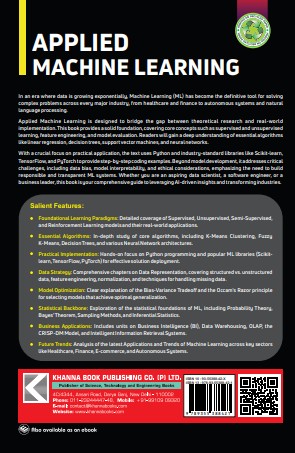
In an era where data is growing exponentially, Machine Learning (ML) has become the definitive tool for solving complex problems across every major industry, from healthcare and finance to autonomous systems and natural language processing.
Applied Machine Learning is designed to bridge the gap between theoretical research and real-world implementation. This book provides a solid foundation, covering core concepts such as supervised and unsupervised learning, feature engineering, and model evaluation. Readers will gain a deep understanding of essential algorithms like linear regression, decision trees, support vector machines, and neural networks.
With a crucial focus on practical application, the text uses Python and industry-standard libraries like Scikit-learn, TensorFlow, and PyTorch to provide step-by-step coding examples. Beyond model development, it addresses critical challenges, including data bias, model interpretability, and ethical considerations, emphasizing the need to build responsible and transparent ML systems. Whether you are an aspiring data scientist, a software engineer, or a business leader, this book is your comprehensive guide to leveraging AI-driven insights and transforming industries.
Salient Features:
- Foundational Learning Paradigms: Detailed coverage of Supervised, Unsupervised, Semi-Supervised, and Reinforcement Learning models and their real-world applications.
- Essential Algorithms: In-depth study of core algorithms, including K-Means Clustering, Fuzzy K-Means, Decision Trees, and various Neural Network architectures.
- Practical Implementation: Hands-on focus on Python programming and popular ML libraries (Scikit-learn, TensorFlow, PyTorch) for effective solution deployment.
- Data Strategy: Comprehensive chapters on Data Representation, covering structured vs. unstructured data, feature engineering, normalization, and techniques for handling missing data.
- Model Optimization: Clear explanation of the Bias-Variance Tradeoff and the Occam’s Razor principle for selecting models that achieve optimal generalization.
- Statistical Backbone: Exploration of the statistical foundations of ML, including Probability Theory, Bayes’ Theorem, Sampling Methods, and Inferential Statistics.
- Business Applications: Includes units on Business Intelligence (BI), Data Warehousing, OLAP, the CRISP-DM Model, and Intelligent Information Retrieval Systems.
- Future Trends: Analysis of the latest Applications and Trends of Machine Learning across key sectors like Healthcare, Finance, E-commerce, and Autonomous Systems.












Reviews
There are no reviews yet.