


Description
Software Engineering
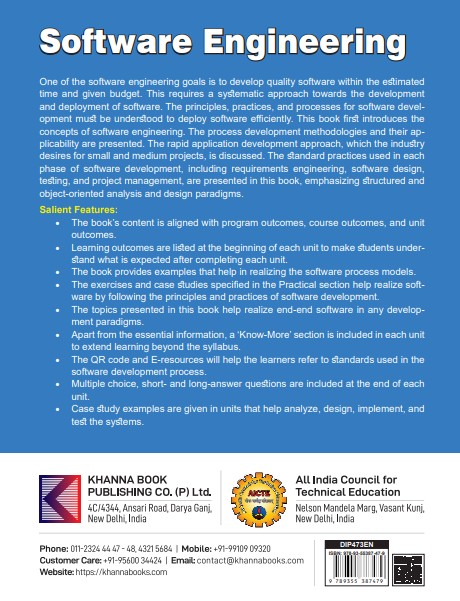
One of the software Engineering goals is to develop quality software within the estimated time and given budget. This requires a systematic approach towards the development and deployment of software. This practices, and processes for software development must be understood to deploy software efficiently. This book first introduces the concepts of software engineering. The process development methodologies and their applicability are presented. The rapid application development approach, which the industry desire for small and medium projects, is discussed. The standard practices used in each phase of software development, including requirements engineering, software design, testing, and project management, are presented in this book, emphasizing structured and object-oriented analysis and design paradigms.
Salient features:
- The book’s content is aligned with program outcomes, course outcomes, and unit outcomes.
- Learning outcomes are listed at the beginning of each unit to make students understand what is expected after completing each unit.
- The book provides examples that help in realizing the software process models.
- The exercises and case studies specified in the practical section help realize software by following the principles and practices of software development.
- The topics presented in this book help realize end-end software in any development paradigms.
- Apart from the essential information, a `know-more’ section is included in each unit to extend learning beyond the syllabus.
- The QR code and E-resources will help the learners refer to standards used in the software development process.
- Multiple choice, short-and long-answer questions are included at the end of each unit.
- Case study examples are given in units that help analyze, design, implement, and test the systems.









Reviews
There are no reviews yet.