



Description
Embedded Systems
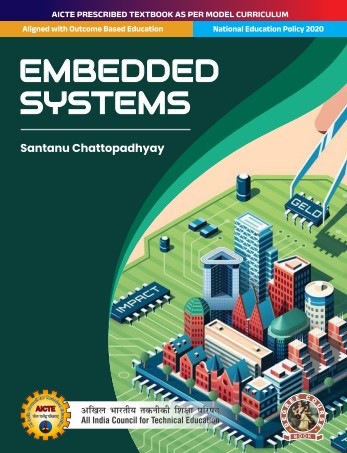
This book is designed for the course on Embedded Systems. It begins with the discussion on basics of embedded system and its features. The host processors, generally used in an embedded system design have been enumerated. In the process, the ARM processor, Digital Signal Processor, FPGA and ASIC have been introduced. Special types of interfacing standards are employed to connect devices to the processor. Non-conventional interfacing standards used in embedded systems like SPI, I2C, RS-232, USB, IrDA, CAN and Bluetooth have been discussed. ADCs and DACs are used for interacting with the analog world. Buses like PCIe and AMBA are employed for developing a complete system. For larger embedded applications, Real-Time Operating Systems (RTOS) are used to realize and schedule the processes, along with their resource requirements. The language Embedded C has become the de facto standard for realizing embedded system programs. The language has been introduced with a large number of example programs. In order to keep the cost of an embedded system less while satisfying the area, performance and power constraints, it becomes necessary to partition an embedded application into set of modules which are realized either in software or in hardware. Hardware-software co-design and co-simulation techniques are employed to achieve the same. The book gives the readers a good understanding of all these topics. A good number of examples, exercises and references act as the starting point to the domain of Embedded Systems.
Salient features:
- Covers embedded processors – ARM, DSP, FPGA, ASIC.
- Discusses special interfacing standards for embedded systems – SPI, I2C, CAN, USB, Bluetooth.
- Enumerates the essentials of RTOS and embedded programming.
- Presents hardware-software cosimulation and codesign techniques.









Reviews
There are no reviews yet.